
 It’s 2001, and our favorite awkward plumber brother makes his rise, quite literally, from the shadows. That’s right, I’m talking about Luigi’s Mansion, ironically the first actual Mario title for the Nintendo GameCube. It’s definitely not something one would expect to pilot the fresh new home console, but Nintendo had quite the amount of faith in the green brother to bring success. This confidence was greatly rewarded, as Luigi’s Mansion went on to become the best selling launch title for the GameCube.
The folks over at Nintendo essentially just combined the Mario franchise with Ghostbusters and had Luigi as the protagonist. In a lot of ways, it’s unoriginal, yet extremely creative and completely ridiculous. I guess you could say this is Nintendo’s secret to success in a lot of ways: relying on familiar faces and names, while putting them in surprisingly fresh and scenarios. In this case, Luigi finally gets his time in the limelight and even wins his own mansion in a lottery! Of course, just when things seem up for Luigi, it turns out his dream mansion is a haunted estate infested with a melange of ghosts and specters. To make matters worse, it seems that Mario has been kidnapped (maybe “spirited away,” you would say?).
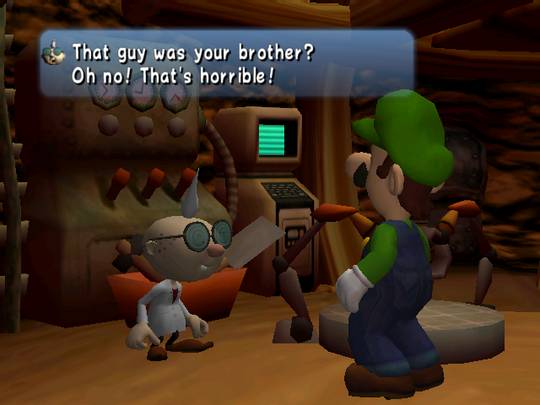 With the help of the scientist and inventor, Dr. E. Gadd, Luigi dons the Poltergust 3000, a contraption invented to suck up unruly spirits as well as having the capability to fire off a variety of elemental attacks. In order to capture runaway ghosts, Luigi has to stun them with a burst of light from with handy flashlight and then proceed with the vacuum action. One of the funnest aspects of Luigi’s Mansion is the sheer amount of enemies Luigi encounters throughout the game. He’ll find normal ghosts that will attempt to punch, grapple, and drop bananas everywhere, as well as 50 wandering Boos with different names. However, the coolest enemies are the Portrait ghosts, spirits that escaped from their paintings and act as the mansion’s unwelcome residents. These vary from the house dog, the butler, a spoiled baby, and even some toy soldiers. Unlike normal ghosts, these each have specific weaknesses, often requiring Luigi to interact with the environment, that must first be exploited to be defeated.
The graphics in Luigi’s Mansion really helped to showcase what the GameCube was capable of in comparison to the N64. The movements are nice and smooth, but the greatest visual aspect is probably the use of lights and shadows. The contrasts and shadows that are cast are wonderfully done. The music is appropriately creepy, yet playful, with pulsing synthesized organ music, and, along with Luigi’s frightened humming, paints an interesting atmosphere.
I think Luigi’s Mansion represents the Nintendo ideology in a lot of ways: to always push the envelope while maintaining a level of familiarity and security that consumers can feel comfortable with. This method doesn’t always work, but I think it’s safe to say that Nintendo’s risk-taking paid off with Luigi’s Mansion since we’re set to receive the sequel, Luigi’s Mansion: Dark Moon for the 3DS, next month!
Cons:
- It’s a short game overall. A veteran can 100% it in under 10 hours.
- Boolossus is one of my least favorite boss battles of all time.
Pros:
- Fun and unique game mechanics that bring out the Ghostbuster in all of us.
- Some of the coolest enemies in the form of the Portrait ghosts.
Check it out:
B.W.
 Mahou Tofu