
 It’s a Pokémon game…about taking pictures… Sounds completely ridiculous, and it is, but we bought it up didn’t we? Released in 1999 (at the height of the Pokéwave), Pokémon Snap is further proof that names and faces can sell just about anything. Had it been called Super Photo Safari 64, profits would most likely be nonexistent. Putting the notoriety aside, where does that put Pokémon Snap in terms of gameplay experience? Taking pictures as a mechanic in games isn’t exactly a foreign one by today’s standards. Who could forget hunting down banana faeries in Donkey Kong 64 or running around with the Picto Box in both Majora’s Mask and The Wind Waker, right? But, Pokémon Snap is probably the first and only time anyone has ever played a game that was all about snapping that perfect shot.
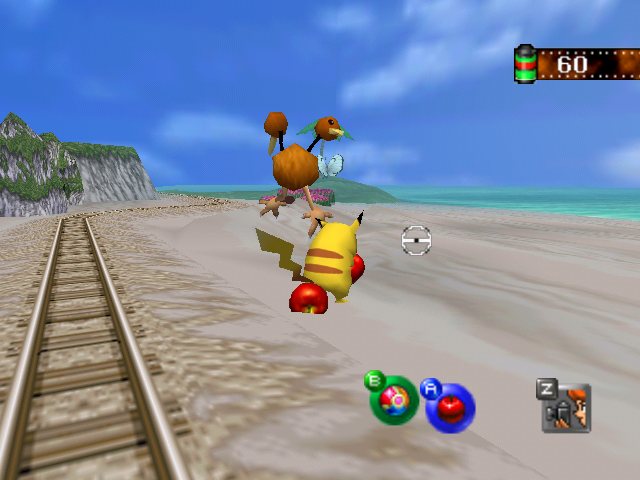 We play as Todd, who is being employed by Professor Oak and must collect research data in the form of beautifully composed photographs. We’re sent to a strange island with a multitude of geographic features, like a sunny beach, a dangerous volcano, and a raging valley, to observe a great variety of Pokémon in their natural habitats. Quite the change of pace from the usual brawling associated with Pokémon, huh? Luckily, we’re also equipped with a variety of tools like an all-terrain vehicle, which acts as the rail of this first-person shooter that guides us throughout each stage. There are also items that can be unlocked such as Pokéfruit (apples), Pester Balls (smoke bombs), and the infamous Pokéflute. Using these on certain Pokémon will produce interesting effects and make for even more dynamic shots! Just don’t tell PETA, okay?
Like a rail shooter, Todd is automatically guided around the stage (think Disneyland’s Fantasyland rides) and can shoot up to 60 photos before his roll of film is used up. One of the things I really enjoy about the game is the sheer diversity of environments in the game. Seeing how the Pokémon interact with their habitats is also really fun. From dunking Charmeleon into lava to make it evolve to having Slowpoke fish for Shellder to guiding a Magikarp to evolution, the amount of stuff we can do in the game is pretty amazing. The graphics are nice as well, holding up to the 3-D found in Pokémon Stadium, and the Pokémons’ movements are fairly fluid as well, adding a nice touch of realism. The music isn’t really anything special unfortunately and sounds kind of cheap as well (though, the Valley theme is pretty groovy).
 Because of the amount of variability that can be had with each stage, the replay value of this game is tremendous, and it takes multiple run-throughs just to find every Pokémon. Finding out which poses and composition styles that the tasteless Professor Oak likes is half the fun and 100% of the pain. I swear, nothing invoked anger quite like hearing him say “You were close!” Hours and hours were poured into this title, and I must admit that a 3DS iteration would definitely tickle my fancy. The gyroscope, as well as the 3-D, would surely see some very practical use in such a game. So how about it, Nintendo?
Cons:
- Music is fairly generic, though fitting for each atmosphere.
- All original 151 were not included, unfortunately.
- Professor Oak is of the unsophisticated bilge and cannot comprehend the makings of true art.
Pros:
- Despite only having 7 levels, the amount to do, and the variability that can come with each trip, is staggering.
- IT’S POKÉMON!
B.W.
 Mahou Tofu