
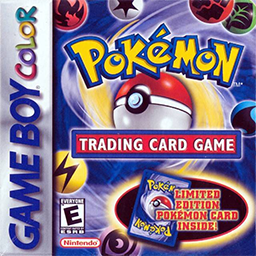
 Back in the day, the Pokemon franchise infiltrated almost every medium imaginable and eventually produced its own trading card game. Unlike other franchises that joined the TCG hype just to make a quick buck, the Pokemon trading card game was actually a fun experience and has expanded to what it is today. The GameBoy adaptation, released in 2000, remained faithful to the actual mechanics of the card game, making a great alternative for people didn’t want to shell out the money for the cards. I don’t know about you guys, but even though I had this game as well as the cards, I could never find anyone to play the card game with, leading me to pour hours upon hours into this great game.
This game was much like the main line of Pokemon games, in that you took on the role of a mute protagonist whose goal was presumably to be a Pokemon champion. Similarly, your objective in this game was to take on the island’s eight gym leaders, thereby granting you access to challenge this game’s version of the Pokemon League. While there wasn’t a huge overworld like in the main series, you were able to walk around inside buildings, with a small overworld that connected each location.

That’s right. I rock and you suck.
The gyms had a variety of duelists to play against, and as you won more duels, you were awarded additional random cards to enhance your deck with. You could also rematch these trainers whenever you wanted to, which allowed you to win more cards and granted more options for deck building. The rules of the card game were actually quite simple. Before the duel, you would set out a certain number of “prize cards,” and each time you knocked out an opponent’s Pokemon card, you were allowed to draw one of your “prize cards.” The first person that drew all of his or her prize cards won the duel. The game, like the actual TCG, utilizes an Energy system, in which Pokemon require a certain amount of Energy cards to use attacks. The catch is that only one Energy card can be played per turn, adding to the strategy. There were hundreds of Pokemon cards available for you to use in the game, including many of the TCG’s early sets of cards and a few “legendary” in-game exclusives. This amount of variety, coupled with free reign of making and saving decks, allowed for hours and hours of replay value.
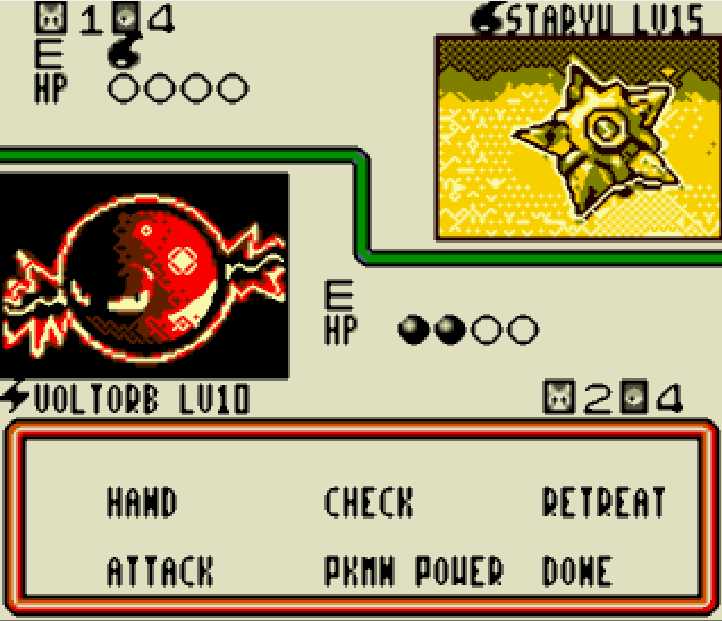
That Voltorb’s gonna get knocked-out!
As far as graphics go, they were what you would expect from a GameBoy game. The cards themselves looked more or less exactly as they do in real life, which was great, and the sprites were fairly similar to those of other Pokemon games. A neat thing you got to see was a little animation for each Pokemon attack, ranging from little fires to massive lightning bolts flashing across the screen. But the best part of the game for me was the music, composed by Ichiro Shimakura (Mario Party 3 & 4). Each of the duel themes just had that energy that made you want to play and kick ass. It’s very rare for a game to have a soundtrack where every track is a winner, but I believe this is one of those few games.
Cons:
- Lack of exploration and overworld makes it feel a bit confined.
- The game began to feel outdated when newer cards came out in real life.
Pros:
- Easy to learn how to play, but the good AI will still give you a challenge.
- Amazing music, especially the duel themes.
- Faithful to the actual trading card game.
B.W.
 Mahou Tofu